
The lineup of seminars for 2026! Free!
Seminar 2 – 29 July 2026 @18h00 (UTC +02:00)
Registration: https://lnkd.in/dUVdvtBj
Topic: My journey with systems thinking – and its increasing importance in the future workplace
Presenter: Professor Marita Turpin
Throughout my career at the CSIR and University of Pretoria, systems thinking has remained a favourite, due to its conceptual beauty, its holistic rightness and its practical value. In my talk, I will share highlights of a number of interesting systems thinking applications, spanning various approaches ranging from systems engineering and systems dynamics to soft systems methodology and critical systems heuristics. Recently, systems thinking has received renewed recognition when it was noted as a core skill for 2025 in the World Economic Forum’s Future of Jobs report. It was further recognised as a skill to become increasingly important towards 2030. I will reflect on why systems thinking is receiving renewed attention, what this means for us as systems practitioners and how systems thinking might enable us to display thought leadership in an era of increased socio-technical complexity and an increasing presence of AI.
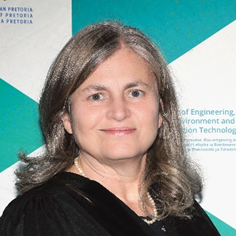
Marita Turpin is a Professor in the Department of Informatics, School of IT, University of Pretoria (UP). Before joining the University, she worked in the fields of Operations Research and Decision Support at the CSIR. She holds qualifications in Mathematics and Applied Mathematics, as well as a PhD in Information Technology which she obtained from the University of Pretoria. Her research interests include the broad domains of the societal impact of disruptive technologies and ICT for sustainable development. Her teaching interests include the development of thinking skills for the future world of work, which includes analytical thinking, systems thinking, design thinking, critical thinking and problem solving. While working in the field of decision support at the CSIR, she became interested in holistic approaches to investigate messy socio-technical problems, due to the limited success of purely analytical approaches. While engaging with both ‘hard’ and ‘soft’ Operations Research, she was able to learn and apply various systems approaches, which included systems dynamics, systems engineering, soft systems methodology (SSM) and the multiple perspectives approach. During her PhD studies, she developed a systems framework to do impact assessment, that made use of autopoiesis and SSM. At UP, she has been teaching systems thinking to a variety of academic audiences. She has supervised students on the use of systems approaches such as Critical Systems Heuristics, the multiple perspectives approach and SSM. Several of these systems-based projects have been published in conference proceedings and academic journals.
Seminar 1 – 25 March 2026 @18h00 (UTC +02:00)
Presenter: Ivan Taylor, Senior Researcher in System Dynamics, Policy Dynamics Inc.
Ivan W. Taylor, PhD, is a Senior Researcher and applied scientist with more than four decades of experience in System Dynamics, systems engineering, operational research, and public policy analysis. He is President of Policy Dynamics Inc. and Scientist Emeritus at Defence Research and Development Canada, where his work has supported decision-making across infrastructure, healthcare, cybersecurity, energy, and social systems. Dr. Taylor has an extensive record of peer-reviewed publications and applied modelling projects, and he has held leadership roles within the International Council on Systems Engineering (INCOSE) and the System Dynamics Society. His current work focuses on integrating lifecycle, socio-technical, and sustainability considerations into rigorous systems engineering practice.

Topic: Systems Engineering Perspective on Reducing Impact without Escalation or Wishful Thinking
Despite increasing investment in sustainability initiatives, environmental and social impacts continue to worsen. This presentation argues that the failure is not one of intent, but of system design. Drawing on the International Council on Systems Engineering (INCOSE) Systems Engineering Handbook and the Systems Engineering Body of Knowledge (SEBoK), sustainability is framed as an emergent system property shaped early on by boundaries, constraints, architecture, feedback, and governance, rather than as a target or program added later. Insights from the INCOSE Natural Systems, Social Systems, and Sustainability Working Groups are used to show how long-lived systems maintain stability. Natural systems operate within hard limits and protect slow-changing stocks, while Indigenous societies embed governance, responsibility, and long time horizons directly into social structure. The presentation shows how systems engineering can apply these lessons during early design to make unsustainable behaviour difficult, visible, and costly by design, avoiding escalation and policy resistance.
Seminar 3 – 28 October 2026 @18h00 (UTC +02:00)
Venue:
Topic: TBC